
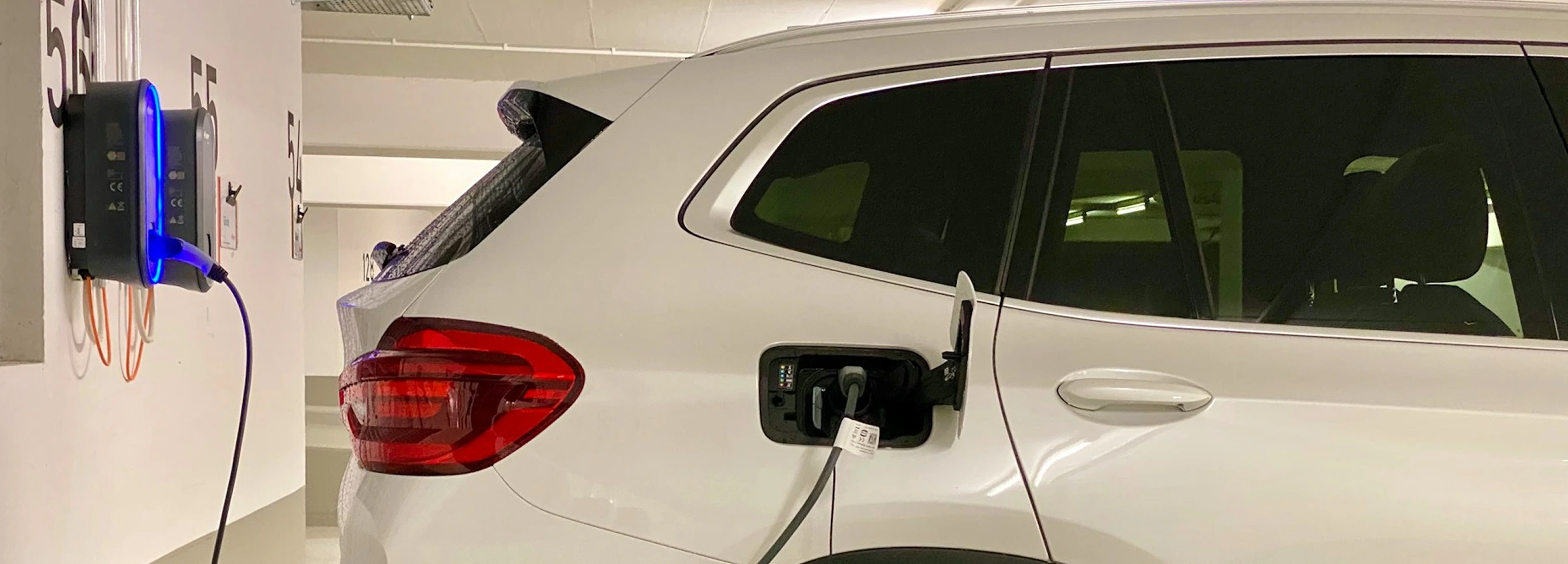
Electromobility is rapidly finding its way into companies, residential complexes, and public facilities. However, with every additional wallbox, the load on the power grid increases. This is exactly where it is decided whether charging infrastructure is operated efficiently, economically, and in a future-proof manner. The answer to this is load management.
Key takeaways
- Load management prevents overloads when multiple wallboxes are used simultaneously
- Dynamic load management distributes available power automatically and according to demand
- A wallbox with load management reduces grid connection costs and ongoing electricity costs
- Wallboxes with intelligent load management allow for fair prioritization of different user groups
- ParkEfficient combines charging, user management, and billing in one central system
Why load management for wallboxes is essential
As the number of electric vehicles increases, the demands on charging infrastructure grow. Without intelligent load management, problems can quickly arise. When multiple vehicles charge at the same time, load peaks occur, which can trip circuit breakers or necessitate expensive grid upgrades.
Especially at locations with many charging points, such as company parking lots, residential complexes, or office districts, a wallbox without load management is no longer state-of-the-art. Instead, systems are needed that distribute available power sensibly and take actual demand into account.
Load management ensures that all vehicles are charged reliably without overloading the power grid or causing unnecessary costs, thereby return on investment actively increasing.
Dynamic load management explained simply
With dynamic load management, the available electrical power is not fixedly divided among individual charging points. Instead, the system adjusts the charging power in real time.
This means:
When fewer vehicles are charging, they receive more power.
When many vehicles are connected at the same time, the power is distributed fairly.
A wallbox with dynamic load management takes the following into account, among other things:
- Number of active charging sessions
- Current grid capacity of the building
- State of charge of the vehicles
- Stored priorities or departure times
This keeps the total load stable while ensuring all users are reliably supplied.
Wallboxes with load management in everyday business
Companies in particular benefit from wallboxes with load management. Employees, company cars, visitors, and pool vehicles have different charging needs. An intelligent system can automatically account for these differences.
Practical examples:
A company car needed for field service receives prioritized charging power.
An employee's private electric car charges more slowly when there is sufficient time.
Visitor vehicles receive a defined minimum charge for the drive home.
This intelligent control keeps operations stable and transparent without the need for manual intervention.
Billing and fairness when charging
Another decisive factor is accurate billing. Without digital systems, it is almost impossible to properly assign charging sessions to users.
Modern solutions enable:
- Private EVs can be charged at the employer's premises
- Billing based on kilowatt-hours
- Combination of charging time and energy consumption
- different tariffs for employees, guests, long-term parkers and company cars
- automatic allocation to cost centers
All charging processes are fully documented and can be analyzed in compliance with GoBD standards. This reduces administrative effort and creates transparency for both users and companies.
Sustainability through intelligent load management
Load management is not just a technical solution, but also a key lever for sustainability. By specifically controlling charging times, loads can be shifted to periods of low power consumption or high self-generated power production.
Companies with photovoltaic systems can prioritize charging when their own solar power is available. This reduces both emissions and electricity costs simultaneously.
In addition, digital systems provide reliable data for ESG reports. Electricity consumption, charging times, and potential savings can be analyzed and documented at any time.
ParkEfficient: Load management, charging, and billing in one system
ParkEfficient connects charging infrastructure with intelligent user control and billing. The system knows which vehicle is in which parking space, who is charging, and how long the charging requirement lasts.
In combination with wallboxes featuring load management, ParkEfficient enables:
- dynamic control of charging power in real time
- prioritization of different user groups
- automatic billing per user or cost center
- transparent reports for energy, usage, and ESG
- integration of existing charging hardware via open interfaces
The entire process is handled digitally. From booking the parking space to the charging process and final billing. Employees, guests, and fleets use a central system with clear rules and full transparency.
Conclusion: Load management makes charging infrastructure cost-effective
Without intelligent load management, charging infrastructure quickly becomes expensive and complex. With dynamic load management, however, existing grid connections can be used optimally, costs can be reduced, and users can be supplied fairly.
Wallboxes with load management are therefore not an optional extra, but a fundamental requirement for scalable electromobility.
ParkEfficient shows how charging, controlling, and billing can be combined into one system. For companies, this means less complexity, more control, and a future-proof solution for electric mobility.


